
Category: Pacific Crest Trail
Backpacker PCT Project
Pacific Crest Trail Video
In 2006, I walked the Pacific Crest Trail. It was hot dang wonderful. Since then, I’ve found myself building a sizable collection of videos on youtube. I thought that I should revisit my PCT hike, since I had little visual documentation of it (an epic tomb of words can be found on this journal.) It was really enjoyable to search back through my photos of the trip. Most of my content on youtube features actual moving images. I hadn’t explored making slideshows. Aren’t those antiquated? Aren’t I more modern? And yet, a slideshow, 2006 technology one might say, was made. The process inspired me to go back through some of the 21,000 photos on my ibook. Perhaps there will be some more slideshows to come. Myanmar definitely deserves it.
A CDT slideshow can be seen by digging a little into my online presence. hint, hint..
PCT vs CDT: Comparing the Long Trails
A reader, wrote with questions about the PCT vs the CDT. Here, in my own words, I compare them.
First off, here are general impressions with a slant towards not repeating others. In life, we’re faced with summarizing huge topics in few words. This isn’t that. But when asked how the CDT was, I sometimes answer: “It was superb. I was surprised with how consistently beautiful it was.”
And now.. In too much detail… I delve into it.
What’s the difference?
They are both very similar. The Pacific Crest Trail runs about 2,650 miles from Mexico to Canada. The Continental Divide Trail runs about 2,700 miles from Mexico to Canada. The PCT is in the western states of California, Oregon and Washington. The CDT is in the mountain states of New Mexico, Colorado, Wyoming, Idaho and Montana. Those in the know might object to my distance of the CDT. People say that it’s 3100 miles long. It is not! I’m not fully sure what the distance is, but the consensus amongst 2010 Sobos was around 2,700 miles. Feel free to leave a comment if you want to know more. Both trails are really long walks. Both go through desert and mountains. Both have bears and snakes. Both have dry and wet sections. Both have lots of information published about them. Both have reasonable resupply opportunities. They are more alike than they are different.
Which one’s better?
There isn’t such thing as a stupid question. Except that one. I don’t have an answer. I loved the PCT. At the time, it was “the best thing that I’ve ever done.” The CDT has not surpassed that, other things have. The CDT was not that quality of an experience for me. The PCT was a paradigm shift. It was a radical affirmation of my love of freedom, my love of backpacking, my love of the west, the wilderness and adventure. I’d already known all of those things. The PCT tattooed them on my soul. The CDT is another imprint. While not as impactful, hiking the Continental Divide was even more enjoyable than the PCT.
Why did I like the CDT so much? Well, it was consistently beautiful. It has been said that the CDT has few “connector” segments. That’s true. So much of it is truly worthwhile backpacking. The PCT has the Sierra, hands down my favorite place on earth. It also has other remarkable places like the lower 48’s volcanoes and Northern Washington. Jim Wolf’s divide trail just has more of it. More beauty. More solitude. More adventure. I liked the CDT for those reasons. Part of that adventure comes from a slightly unjust quirk. The CDT has a reputation of being harder. It scares people. It has as a motto, “Embrace the Brutality.” Yogi also publishes that it’s “the PhD of backpacking”. Such a reputation is intimidating. I was scared. Now, I think it’s baloney. I don’t think that long distance hikers should be scared off from hiking the CDT. It’s not that bad! More on this later.
Importantly, I’d learned more about myself on the PCT and in the living I’ve done between the two trails. I know what brings me happiness (the outdoors and relationships). I know what it feels like to death march. I know when a relationship works for me. I know when to be alone, and when to be with others. So, it’s for personal reasons that I enjoyed the CDT more than I enjoyed the PCT. The PCT was more amazing and impactful, the CDT was more enjoyable.
On the PCT I hiked with many different people. I made great friends, but I also spent a lot of time keeping pace with people who I’m no longer close to. Relationships were hard out there. They weren’t as fulfilling. Yes, I had many great ones. I hiked with Pepi for a thousand miles. I met Snail, She-ra, Nemo and loads of other cool people. I was a social hiker. But on the CDT, I made a great hiking partner and that’s what made the trip. It’s that pairing of the outdoors and relationships. It’s that golden ticket. Lost is pretty quiet, but I pried her open and squeezed the juice out. We had fun. We didn’t death march. We compromised. We respected each other We laughed. And we stuck together. It was a great hiking partnership, and it made the trail for me.
So, is the CDT harder?
Probably, but they’re both ridiculously hard. The CDT has some steep climbs. Lots of uuuppp and dowwwnnn, especially along the Montana/Idaho border and in Colorado. On the CDT you find yourself hiking really steep sections. Sometimes, it’s because you are going cross country right on the divide. Ridge walking is never graded. Sometimes it’s because you’re walking an ATV track and thrillcraft love steep slopes. In comparison, the PCT has none of that.
Southbound, I hiked a little faster on the CDT. It’s impractical to start much earlier than the middle of June. Right from the start, I felt the pressure of needing to make big miles to get out of the San Juans before it started snowing. On the PCT, you’re supposed to hike slow at first. There is no need to rush into the Sierra too early. On the CDT, we were all doing about 25 miles a day the entire hike. On the PCT, I had a month of 17-21 miles a day to start the trip.
Speed and terrain are only some of the reasons that trails are hard. For me, the CDT was hard because of physical problems. I hurt my leg. I hurt my ankle. I hurt my foot. I got sick. I walked hundreds of miles when I should have been on bed rest. That’s what made it hard. And that’s what it takes for me to be a thruhiker. Perseverance
I also endured more bad weather on the CDT. Generally, it was good. But sometimes, we had really cold rain while walking right up on that crest. It’s high and exposed. It can be harsh. We had some snow. I got hypothermic. I got FAR too close to being hit by lightning. On the PCT, I had less bad weather. On both trails, it was generally, simply beautiful.
I hear navigation…
You don’t really need to know how to navigate on the PCT. The trail is almost always obvious. It’s well marked. You’re hiking with others. You’re following footprints. It’s generally the widest path. Most PCTers hardly consider their maps. Many PCTers don’t know squat about navigation.
Many CDTers also don’t know squat about navigation. But that doesn’t fly so well out on the divide. It’s not well signed. It doesn’t have a lot of footprints. It’s definitely not always the most major path. It’s often on roads with networks of road intersections. And there often isn’t a single way to hike the trail. On the CDT though, we have GPS. Most CDTers are using GPSs. Yes, it takes the challenge out of it. You look at your screen, see where you are, and see where you need to go. As long as your GPS is working well (it’s not broken, it has batteries, maps and a track), navigating on the CDT is pretty brainless. Hiking the CDT without a GPS requires navigational skill. Having one, not so much. Most people don’t use their GPS all the time. They keep it off and navigate with Ley’s maps and/or Wolf’s guides. Both are outstanding, and if you keep on top of them, you’ll find yourself found.
My experience was quite unique. Since I was collecting information for a map, I had my GPS on all of the time. At every intersection, and every time I was misplaced, I’d have to be working with my GPS anyways. I used my GPS for navigating more than anyone. But I’m also a good navigator. I’ve taught classes and guides about it. So for me, I don’t think that navigation on the CDT is hard. Yes, it requires some skill and attention. But hardly more than a general stout backpacking adventure does.
The CDT has a reputation for more wildlife.
One thing that I’ve realized pretty deeply through my travels is that we’re royally screwing the environment. Yes, the CDT has more wildlife than the PCT. But it doesn’t have much! The PCT is pretty barren of animals. The CDT has some more, but it’s no Serengeti Does the myth of the wild seregeti still hold? The myth of wild america is tottering in my eyes. I saw nine bears. One was a grizzly. I saw about as many hunters as elk and deer. I saw about two hundred pronghorn antelope but no herds of hundreds. I saw half a dozen wild horses. Two rattle snakes. Lots of evidence of beavers, but no beavers. Lots of evidence of coyotes, large cats and badgers, but none of them either. I know that wild animals hide. I know that they’re often more active at night. And I know that their population has dwindled greatly. It’s our fault. I’m changing the climate. I’m encroaching on their homes. I’m letting toxins enter the environment. I don’t hunt, but MILLIONS of Americans do. It’s no wonder that the myth of the wild CDT is just that to me, a myth. The best wildlife encounter from the summer was truly remarkable however. I stood and stared for many minutes as four juvenile martens scampered, screeched and stared back from only four feet away.
What about money?
I spent about $1,000 more on the CDT. Hotels were a little more expensive and I shared them with fewer people. I went to a doctor. I replaced my shoes more often, replaced my camera and payed more to get to and from the trail. Personally, I’d be fine with $4500 for the PCT and $5500 for the CDT, but I spent about five hundred dollars more than that.
Let’s talk gear…
What worked for you on the PCT will probably work well on the CDT. Sobo, I stupidly prepared for October at 14,000 feet (Colorado) when I was hiking in June and July in Montana. Go light. It’s not that bad. Except Colorado. Bring more warm clothes for Colorado. I do a light fleece under my rain jacket. I think that’s critical when it’s foul out. That’s a garment that I don’t normally carry in the summer. But September in Washington and September in Colorado? Be prepared.
Otherwise, gear can be the same. Ultralight, fringe stuff works well enough. Go light. Know that there were a few more times on the CDT when I set my shelter up without a tree to be seen. That could be a problem if you’ve got a shelter that requires trees to set up. Some hikers manage it though.
CDT as first long hike?
Doing the CDT as your first long hike is very uncommon. It’s commonly said that you’ll learn skills on the PCT that are useful on the CDT. Sure! One problem with doing the CDT first, is that you might not know some of the tricks. Does that mean that you’ll fail? Probably not. It’d be more of an adventure, it might be too much of a kick in the pants, but you’ll probably be fine. Know that there might not be anyone out there to “show you the ways”. You might flail along without the accumulated knowledge of the long distance community. If you’re someone who like to figure things out for themselves, I think it’d be a grand adventure. Long hikes teach you about your physical limits, your ability to hike through hardship, how to resupply, how to save money, how to be efficient, what informational resources are available, what gear works and is light. If it’s your first thruhike, hopefully you’re not heading out there with 60 pound packs, big leather boots, the CDTA guidebooks, a faulty resupply schedule, not enough water and food and no wilderness skills. You might just have a grand adventure though!
Northbound or Southbound?
My guess is that 55% of people go northbound. People are excited to get started and don’t want to wait until June. Northbound, if there is snow in Colorado when you get there, you might have problems. Many nobos flip ahead, or walk around some areas. A few go through. I haven’t done it, but it seems like there would be some seriously sketchy and steep snow slopes to cross if you are doing Colorado in the snow. Southbound doesn’t have that obstacle. Glacier can be problematic. But there are decent alternates. And it’s short, just south of Glacier, snow shouldn’t be a problem.
Solitude?
There is plenty of opportunity for solitude on the CDT! People sometimes choose to intentionally stick together because if they don’t, they’re not really going to see anyone else. The CDT really is quite empty. The PCT is more social.
How about town?
Both the PCT and CDT have great towns. Enjoy them!
Thanks for reading! Any more questions? Leave a comment and I’ll be happy to try to answer them.
GPS Track and Waypoints of the Pacific Crest Trail
Hey Community!
I’d just like to too my own horn a little. Toot-Toot!
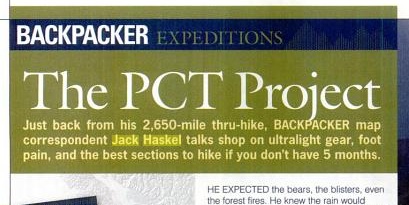
The current issue of Backpacker Magazine, February 2007(!) has a short interview with me in it. It’s titled “The PCT Project”. They hooked me up with a GPS, some shoes and socks and funding to hike the trial this summer. In exchange, I kept the GPS on all of the time and recorded waypoints and a track log of the whole trail.
Every 40 feet or so the unit recorded a bread crumb and every mile or so I recorded a waypoint. Waypoints are points of “interest”, so deemed by yours truly. Mostly, waypoints are the water sources, trail junctions and roads along the trail. Some pictures that I took will be attached to the data. The magazine blurb is in print but the data hasn’t been posted yet. Hopefully it will be in then next few days. You’ll see it at backpacker.com/hikes
It’s a pay website ($15/year). But there is a 90-free trial, during which you can download the track and the Google Earth file. Funny thing is, the whole PCT is far too big to load in to a GPS unit. There goes your hopes of hiking the trail with a GPS crutch huh? Luckily, as someone that HAS hiked the PCT with GPS, I can confirm that it’s truly NOT necessary. What this project does provide, is a new detailed track and more importantly a waypointed track! Trust me, it’s super cool when loaded in to Google Earth. And it doesn’t have the weirdness of the Forest Service track which thinks that we want to view the hike southbound.
To you avid thru-hikers, some of the interview might make be seem like a bozo. Trust me, I am. But understand that a magazine interview such as this is largely “paraphrasing” from a long conversation. Still, I’m really happy with the end result. I spent a week in Boulder with the Map staff. They’re top notch and doing some cool GPS mapping of the states. The AT was also (hopefully) mapped this year and they’ve got an interesting project for the CDT next year. I STRONGLY encourage the long distance hiking community to look in to the CDT project. It’s introduced in this same issue and you can sign up for the project (if you so choose) at backpacker.com/cdtmap
So,
– I’ll write again when the track is actually online.
– First person that finds a spike off the trail (which marks a spot where I hiked off to go to the bathroom), gets a fresh, steaming pile of poo via Priority Mail.
– First person that actually uses this track, better give me feedback!
Kindly,
Jack “Union” Haskel
P.S.: Like many hikers in ’06, I skipped a burning section in Oregon around Mt. Jefferson. So there’s a 50+ mile gap in my life which I hope to hike and GPS next summer.
Post Hike thoughts
Hey Friends!
I hope everyone is great. I mean really, really great. I’m just writing to keep in touch…
Hmmm… It’s been almost two months since I finished. What have I done? Um, not much. heh. I’m living at home in SF which is pretty nice. I eat well on my parents dime and have very low expenses. I’m trying to keep in good shape but the huge portions that I continue to eat are giving me a nice bit of pudge.
I really went through (am going through) a good bit of reentry regrets. Damn I wish I was still hiking. Lucky for me, I have no job so I do actually get out and hike. I went backpacking right away in the local oak woodlands (Ohlone Wilderness), did another backpacking trip out at the coast (Point Reyes) and went car camping down at this cool ancient volcano (Pinnacles). Keeping sane I guess. San Fran is pretty damn far from the Sierra though and I’m missing it badly. I’ll hopefully head up there soon. I’m still GPSing all my hikes. The first one I didn’t log and every time I got to a gate or a trail junction, it felt strange to not stop for a waypoint. Count another future CDTer here too.
Backpacker told me that if I submit some more trips, they’ll exchange my GPS for a GPS cellphone with minutes that I can use. That’d be nice. I spent a week in Boulder sorting through the data. The project has turned out to be pretty damn cool. And yes, you can actually see some of the times that I walked off trail to take a crap  Even funnier though is that the track is too damn big to be of much practical use. You can’t load it in to a GPS!! People, if they so choose, will be able to load sections but not the whole thing. But you can load it in to Google Earth and see the pretty detailed waypoints (turn left here, nice shady oak there, great views over that way, etc). It should be up online sometime in December on backpacker.com/hikes. It’s a pay website ($15/year), but you can sign up for a free trail and download the PCT during that time. There is also a little piece (“The PCT Project”) in the magazine introducing the map and myself. It’s going into the February issue (which comes out in December). I’ll spam the PCT-L and the yahoo group when it goes online.
In the “not great” department, my feet have stayed bigger. Meaning, many of my old shoes don’t fit! Damn it! Has this happen to anyone else? I’m definitely buying new snow boots but will try to hold off on the other sports. My feet are pretty unhappy in my bike shoes though.
On the job search front, there seem to be some cool ones in this world. I’m going for those. I haven’t heard back from anywhere yet though  I’m pretty much applying to most of the “core” companies and associations in the backpacking universe. I spend my days applying to places all over the country.
When you come to the city sometime in the future, drop me a line. We’ll do something fun!
Cheers,
Jack
 I'm Jack Haskel